Home Services

Business Value Assessment

Introduction

This assessment helps you estimate the market value of your business using your own financial inputs. It follows the typical framework buyers use for owner-operated businesses under $5 million in revenue, focusing on owner cash flow and the risk and transferability of that cash flow.

In simple terms:

Owner Cash Flow x Confidence Score = Estimated Business Value
This tool will help you understand and develop estimates for owner cash flow and the confidence score. It provides a practical estimate of business value based on your inputs and observed private-market transaction ranges.

Contact Information
Please complete all required fields and make sure the email address and website URL are valid.

By clicking Next, you acknowledge that this tool is not financial, legal, investment, tax, or regulatory advice. You understands that results are not a guarantee of the value of the business or what it would be sold for in an actual transaction. This output is not a 409A valuation. Weld disclaims all representations and warranties in connection with this tool's output.

Weld may use the contact information you provide to contact you about our services. You may unsubscribe at any time. Please review our Privacy Policy.

Owner Cash Flow Estimation

Understanding Seller's Discretionary Earnings (SDE) ?

Most owner-operated businesses are priced based on how much money they make for one owner, the owner cash flow. This is referred to as the Seller's Discretionary Earnings (SDE). Buyers look at the business's SDE ? and multiply it by a confidence score, a number referred to as a multiple ?.

Larger, more complex businesses are valued based on a different measure of cash flow called EBITDA. ? *If your business is above $5 million in revenue, has a senior management layer, or multiple different service and revenue lines, you may benefit from one of our analyst-prepared reports.

The more owner cash flow or SDE the business produces, and the more stable and transferable it is, the more the business is worth.

Let's calculate your SDE using your most recent full-year tax return or P&L statement.
Owner Cash Flow Estimation

CALCULATE YOUR SDE ?

Owner cash flow is calculated on an annual basis. Please ensure all values entered reflect the same 12-month period.

If you’re using your tax return, the full - calendar year will typically be the most accurate reference. If you update financials monthly, you can instead use a trailing twelve months (TTM) ? profit and loss (P&L) statement from your most recent financials.

1
Start with Net Profit

Net profit is the money remaining after all business expenses are paid. On tax returns, it is typically reported as net income ?.

2
Add Back Owner Benefits

These line items are what are commonly referred to as "add backs". Add backs are owner-specific expenses that a new buyer would not incur. They're added back to net profit to reflect the full economic benefit of owning the business.

In some cases, an adjustment may need to be subtracted instead. For example, if the owner currently owns the real estate and does not charge the business market rent, a reasonable rent expense may need to be deducted to reflect the true operating cost a new owner would likely incur.

3
Add Back Non-Operating Expenses

If deducted from your earnings, add back interest expense, company income taxes, and depreciation & amortization (D&A).

Estimated SDE ?
$0
Please fill in the Net Profit field to proceed.
Understanding Confidence Scores

How the Multiple Is Determined

The multiple ? (2×, 3×, 4×, etc.) that SDE is multiplied by is mainly driven by business risk ? and transferability ?. Risk and transferability depend on things like:

• Customer concentration
• How dependent the business is on the owner
• Growth history
• Industry demand

But at its core, valuation for small businesses is usually:

Cash to owner × Confidence Score = Estimated Business Value
Commonly referred to by buyers and valuators as
SDE x Multiple = Estimated Business Value
Understanding Confidence Scores

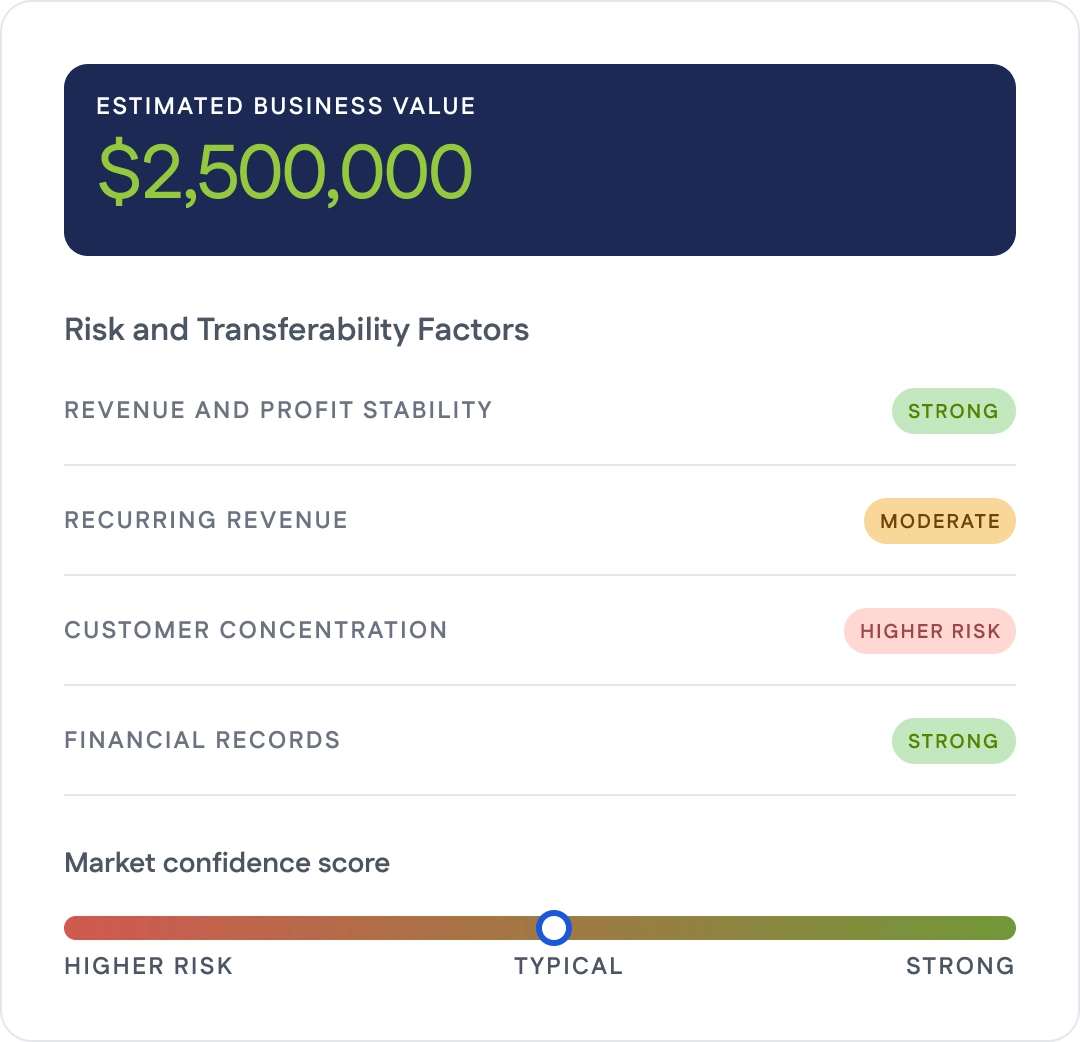
Risk & Transferability Scorecard

Check the box that most closely reflects your current business position.

Revenue and Profit Stability*
Recurring Revenue*
Customer Concentration*
Owner Dependence*
Financial Records*
Market Confidence Score
Higher Risk
Typical
Premium
Based on your selections, your business positioning is:
Lower end of range (higher transition risk)
Middle of range (average market profile)
Upper end of range (strong transferability)

This tool weighs each factor equally to create a general benchmark. In real transactions, however, one particularly strong—or weak—factor can have a larger impact on how buyers view the business and the price they are willing to pay.

Please answer all five categories before continuing.
Understanding Confidence Scores

Estimated Multiple

Based on the most recent transaction data for profitable, privately held U.S. businesses with under $5M in revenue, valuation multiples for Landscape & Lawn Care businesses are distributed as follows:

Metric
Sale Price / SDE
Upper Quartile
-×
Median
-×
Lower Quartile
-×
Based on your scorecard selections, your business likely fits:
Lower end of range (higher transition risk)
Middle of range (average market profile)
Upper end of range (strong transferability)
Value Estimate
-

Based on the inputs you provided, your business generates about $XX  in annual owner cash flow (SDE). Similar businesses have sold for around -x this cash flow, based on recent private-market transactions. Using that benchmark, your estimated business value is approximately -.

Your SDE
Not entered
Owner Cash Flow
× Median Multiple for -
-×
Confidence Score
ESTIMATED BUSINESS VALUE
-
Think of this as a starting point for planning.

Disclaimer: This assessment provides a practical estimate based on owner-provided inputs and observed private-market transaction ranges. It is intended for planning and perspective only — not as a formal appraisal or guarantee of price. Actual outcomes depend on buyer demand, deal structure, business performance, and economic conditions. This is not a 409A valuation.

Strategic Considerations

Steps to Increase Business Value

Based on the information provided, your business appears to be above average in reducing risk and improving transferability. Notable strengths include:

Consistent and stable profitability
Meaningful recurring revenue
A diversified customer base
Reduced dependence on the owner’s day-to-day involvement
Clean, well-organized financial reporting
These characteristics are often associated with stronger buyer confidence and more favorable valuation outcomes.

Note: This assessment looks only at 12 months of business performance. Buyers and lenders typically expect to see at least three years of operating and financial history when evaluating a business, as consistency over time materially impacts both valuation and financing options.
Strategic Considerations

Steps to Increase Business Value

Owners who are years away from a potential exit can take deliberate steps to increase business value before going to market. Improvements in the areas below often lead to stronger buyer interest and, in many cases, higher potential offer prices.

Improving profit consistency and margin stability
Increasing recurring or contracted revenue
Further diversifying the customer base
Reducing day-to-day owner dependence and strengthening second-layer management
Maintaining clean, accurate, and well-organized financial records
In comparable transactions, businesses with lower transition risk have been observed to trade at SDE valuation multiples approximately 0.5×–1.0× higher, depending on industry and overall stability. Actual outcomes vary based on market conditions, deal structure, and buyer demand at the time of sale.

Note: This assessment looks only at 12 months of business performance. Buyers and lenders typically expect to see at least three years of operating and financial history when evaluating a business, as consistency over time materially impacts both valuation and financing options.
Strategic Considerations

Business Value by Multiple
(assuming SDE = -)

A business with the same SDE can sell for over $1M more, depending on how buyers perceive its risk, consistency, and transferability.

Next Steps

How Weld can Support You

The estimate provided is a helpful starting point, but it is based on limited information and simplified assumptions. Many factors that influence a business’s true value—such as financial adjustments, risk factors, and market comparables—require a more thorough review.

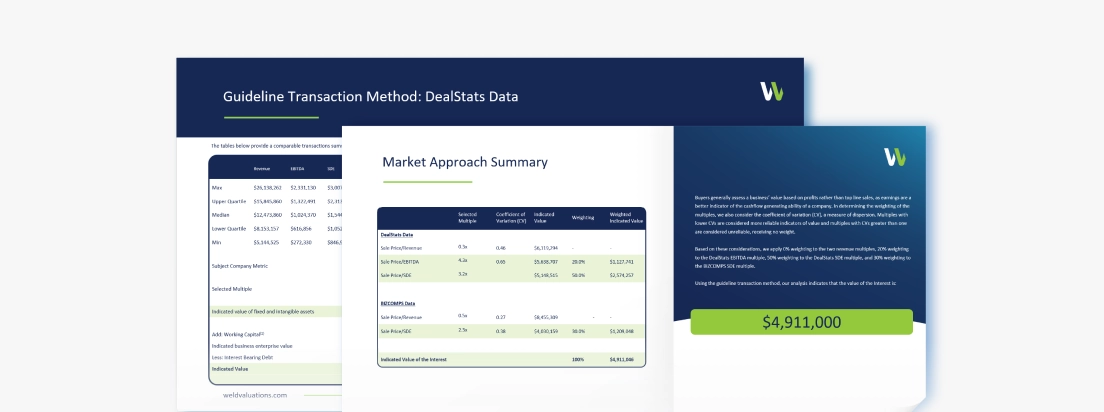
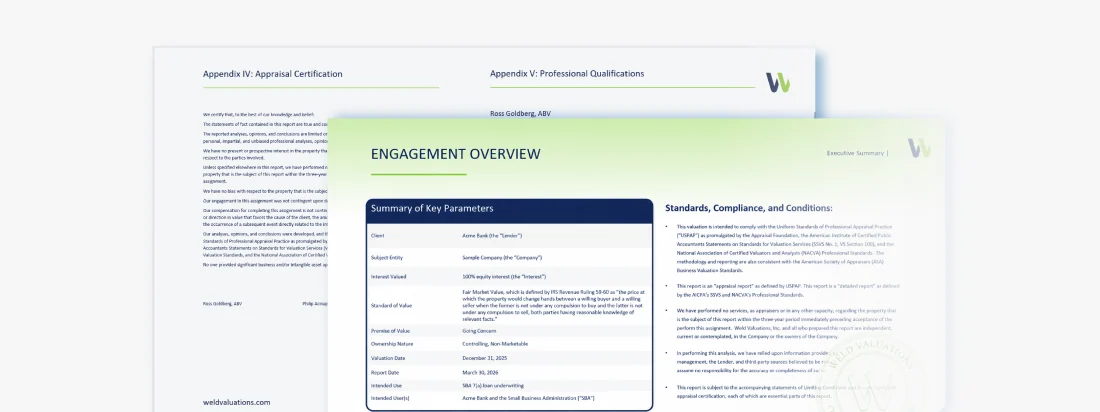
Our analyst-prepared reports can provide a more accurate valuation through a detailed analysis of your financials and a deeper evaluation of how buyers are likely to assess your business.

Please select any products below that you would like to receive more information about.

Download Report
Thank you! Your submission has been received!
Oops! Something went wrong while submitting the form.

Get your valuation today

From a first look at business value to a certified report — every Weld product is designed for a specific moment in the entrepreneurial journey.

Value Estimate

-

Based on the inputs you provided, your business generates about $XX  in annual owner cash flow (SDE). Similar businesses have sold for around -x this cash flow, based on recent private-market transactions. Using that benchmark, your estimated business value is approximately -.

Your SDE
Not entered
Owner Cash Flow
× Median quartile Multiple for -
-×
Confidence Score
ESTIMATED BUSINESS VALUE
-
Starting point for planning.
Steps to Increase Business Value

Based on the information provided, your business appears to be above average in reducing risk and improving transferability. Notable strengths include:

Consistent and stable profitability
Meaningful recurring revenue
A diversified customer base
Reduced dependence on the owner’s day-to-day involvement
Clean, well-organized financial reporting

Owners who are years away from a potential exit can take deliberate steps to increase business value before going to market. Improvements in the areas below often lead to stronger buyer interest and, in many cases, higher potential offer prices.

Improving profit consistency and margin stability
Increasing recurring or contracted revenue
Further diversifying the customer base
Reducing day-to-day owner dependence and strengthening second-layer management
Maintaining clean, accurate, and well-organized financial records

How Perceived Risk Affects Valuation

Based on recent private-market transactions and your estimated SDE:

Metric
Multiple Range
Multiple
Your SDE
Estimated Value
What the multiple suggests
Upper Quartile
-×
-
-
Strong systems, diversified, lower risk
Median
-×
-
-
Stable, typical small business profile
Lower Quartile
-×
-
-
Higher risk, owner-reliant, or inconsistent earnings
Business Value by Multiple (assuming SDE = -)

A business with the same SDE can sell for over $1M more, depending on how buyers perceive its risk, consistency, and transferability.

How Weld can support you

The estimate provided is a helpful starting point, but it is based on limited information and simplified assumptions. Many factors that influence a business’s true value—such as financial adjustments, risk factors, and market comparables—require a more thorough review.

Our analyst-prepared reports can provide a more accurate valuation through a detailed analysis of your financials and a deeper evaluation of how buyers are likely to assess your business.